Showing posts with label learning. Show all posts

Tuesday, 8 January 2013

Ruminating on educating

As it's the beginning of a new academic term, my thoughts have naturally turned to our own educational arrangements. A couple of friends are facing those big decisions about whether to go mainstream or seek alternatives and our conversations have touched on the home education option. It seems like a good moment to look back at our first term and share some thoughts and observations about the business.


It's probably too much waffling for one post, so I imagine I'll spin it out a bit - by which time I'll hopefully have got back into the swing of blogging a bit more regularly.

The decision to home educate is not made lightly. Even I, who had decided almost from Eli's first month that he would not be entrusted to the state for his upbringing, felt some self-doubt creep in when it came to the end of his short time at the local Steiner kindergarten. I hadn't ever properly taken on board the very obvious fact that almost everyone sends their children to school. It is not only expected, it is largely unquestioned.


It seems that the general consensus is that school, whilst not necessarily the ideal option, is the safest. The practical considerations alone give rise to enough consternation to prevent treading another path - bringing in enough money whilst having children at home; not feeling that one has enough resources of energy to be around ones offspring constantly; not having the requisite support network and so on and so on. I am familiar with these anxieties, it can seem logistically impossible before you even get to the education bit.


I think our real fears kick in when we get to our children's well-being and future prospects. Will our children learn all they need to know from primarily being with one person, perhaps two at the most? Will they need more social contact than we can provide for them? How will they learn to read????

These questions and worries are valid and real. A certain amount of self-confidence and a sizeable rebellious streak are useful when contemplating them. I cannot speak for others or offer any sureties but I can share our experience and add to the growing numbers of people who say that school doesn't have to be the only way.

Tuesday, 4 December 2012

Knowing the territory


Ever since I was a girl I've enjoyed being able to name things in the natural world. Walking the woods and waste grounds of my childhood I would feel a flush of recognition and pride if I came across a tree or a wild flower that I knew. I don't know that there were a huge number that I recognised -  wild garlic in the spring, the oak tree and the bluebell were perhaps the only names that came easily to mind - but even this basic knowledge helped me feel part of that landscape. I felt I knew my neighbours.

There were all the usual special places and secret spots - up in the trees or in tangled dens beneath them - long summers were lived in these semi-wilds. I loved them without thinking and when one little patch of woodland was threatened by someone extending their garden, I was angry and grieved for the lost trees when they were gone.


In his book Last Child in the Woods, Richard Louv talks about the need for children to be familiar with their own natural neighbourhood and the occupants of it before they can be expected to care about the earth on a grander, more abstract scale. Faced with the entire planet to worry about, we can be forgiven for feeling overwhelmed. When so much of our natural world faces extinction it makes sense to start with what we know and can name; learning to care about 'the environment' comes as a result of learning to care about our own backyard.


All this feels particularly pertinent in the light of the threat to ash trees. Having read this heartbreaking piece about ash die back, in which the writer gives the bleak view that most people are oblivious to the tragedy happening in our woodlands, this seems more true than ever. If it is the case that 'many people couldn't identify an ash' then what hope is there that they would feel any sadness for its loss? If the general feeling is that one tree is after all much like another, how can we hope to truly be of use to our ailing planet? Diversity is what makes this world go round. The exquisite uniqueness of literally every living thing on or under the surface of this spinning rock is what provides the wonder and magic of our existence.


My naturalist knowledge hasn't improved a massive amount since my early days scrabbling through tatty woods, but I continue to be an earnest learner and I'm trying to encourage a similar curiosity in my children.

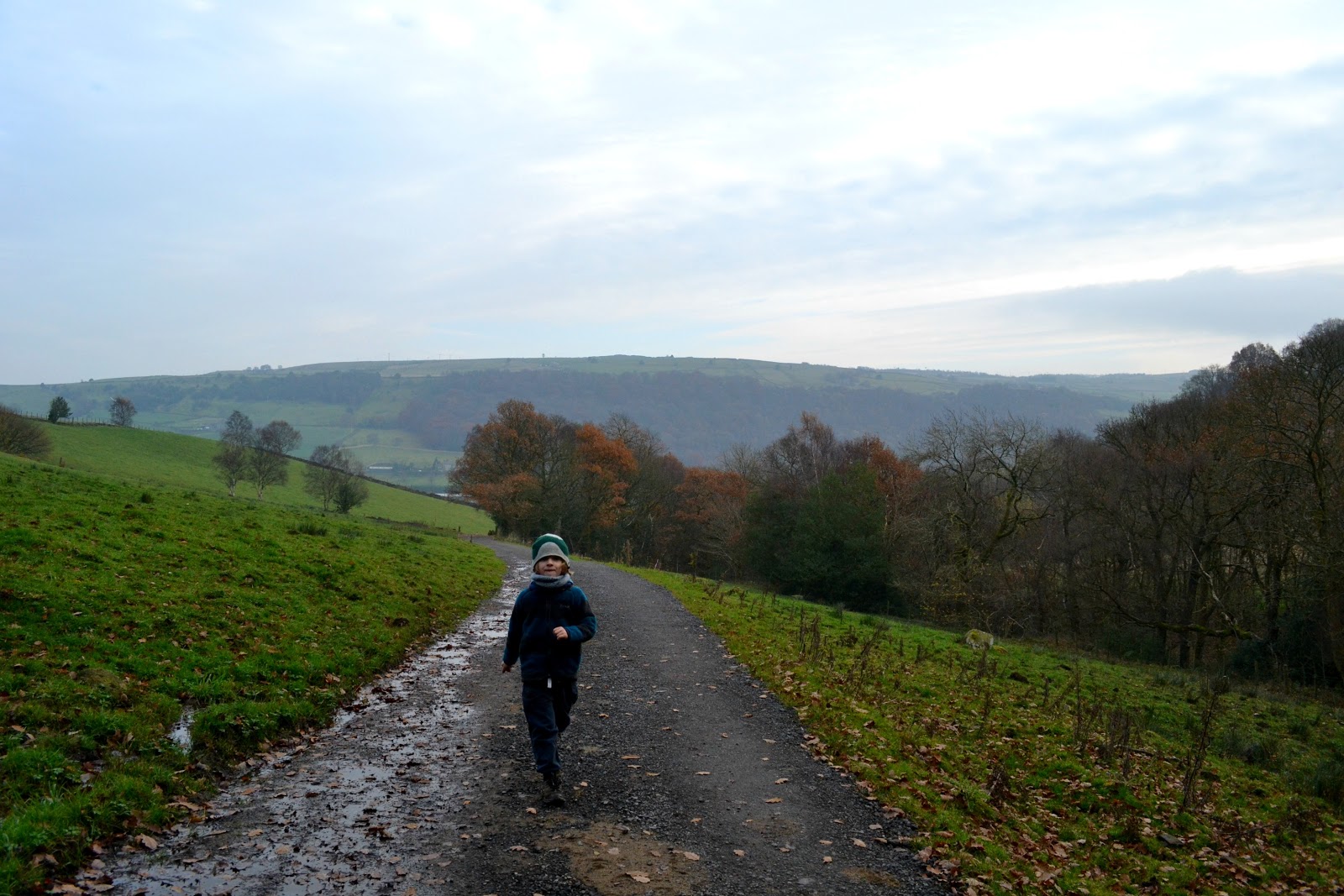
This year, as Monty's legs have grown a little longer, we have spent more time walking, looking and gathering than ever before. Eli has become a keen spotter of wild foods and ash saplings and Monty has fully immersed himself in any berry-picking activities he's been involved in. They have become connoisseurs of dramatic skies and Eli often urges me to 'take a picture!' of a lovely view or a striking flower.


Helping them to know and love the play of light in the woodland, the eerie silence and bleak beauty of the moor, the brooding Pennine skies and the capricious moods of our Northern weather is a constant pleasure. Forging a connection with this place is the key to connection with all natural places, helping us to understand that 'the environment' is something immediate and necessary. No need for worksheets, a pair of sturdy shoes is all that's required. Together we map the seasons of our own backyard,

Friday, 14 September 2012

Flowers and firearms

Our week has been a little wobbly. Tiredness and the realisation for Monty that he is is really away from me when he goes to Kindergarten has left us more emotional than usual. We're trying to be gentle with ourselves, but it isn't easy with two boys who find it hard to be anything other than maximum strength. 

Despite our disarray we did manage to visit a little local museum this week. I'd spotted in a flyer that Bankfield museum in Halifax was holding an exhibition of textiles on the theme of gardens which I was keen to see. I imagined conversations with Eli about the artist's processes; materials and techniques used. I thought we might marvel together at the stitches used liked brush strokes and hoped it  would inspire us to run home and start our own creative project...


I pointed out the journey from photographs, to sketches and finally stitches. We looked at how some of the pieces were layered with sewn fabrics behind screen printed transparent cloth. I enthused over the botanical motifs and impressionistic effects...


Meanwhile, Eli was tugging on my arm, desperately trying to stay patient...because what he was interested in,  what he really wanted to look at...was the Duke of Wellington's regiment museum.

Dutifully, and with little enthusiasm I allowed myself to be lead to look at cases filled with uniforms and weaponry. Along with my discomfort at us being surrounded by the apparel and apparatus of war, I realised my knowledge of battle history was severely lacking. Now I was on shaky ground. I didn't have answers to the questions being asked of me. Waterloo? What was all that about again? American wars? Erm...let me see...


I did manage some vague mutterings about the trenches and we both enjoyed looking at various soldier's personal effects - what they ate from, the bags they carried - the everyday objects that remind us of their humanity rather than the violence they were embroiled in.

Learning together may not always be what I expect it to be. Although I set the agenda for our museum visit, and had my own expectations about what we might explore together, Eli had his own ideas. Those ideas meant that I looked at things I wouldn't otherwise have looked at. I found I was interested in some of those things and I found that when it comes to history I am pretty much clueless.

Time for a trip to the library I think...